Keeping up with Bess the Press

Hello blog readers! I’ve been doing a bad job of keeping you up to date lately… a long post just seems intimidating these days! Please make sure you like us on facebook to stay in the loop: http://www.facebook.com/pages/Bess-the-Press

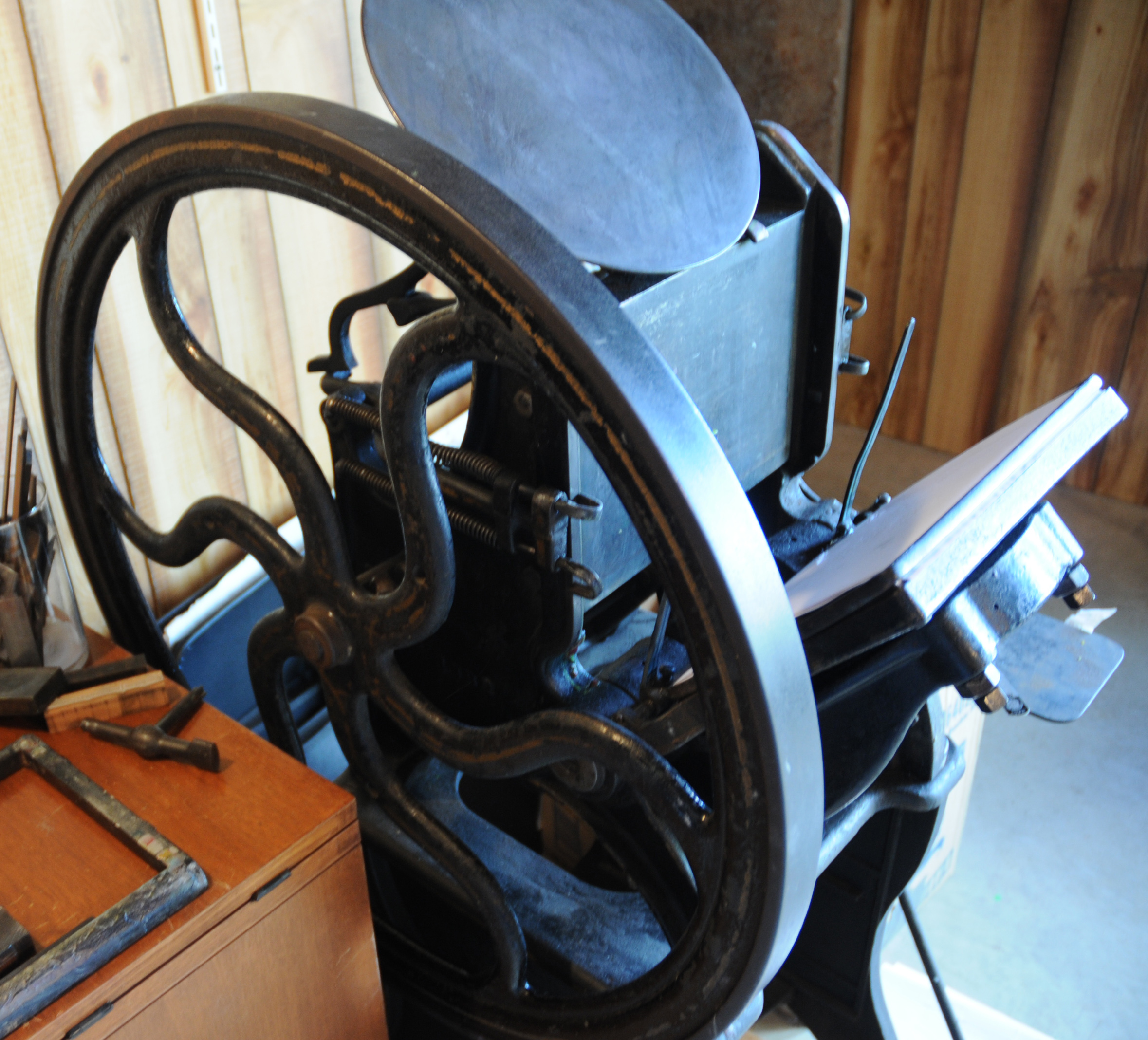
A couple cool things are happening over on that other website: I tried my hand at live micro-blogging this weekend. I had a lot to print and thought it would be fun to give my followers a more real-time experience of what printing is like. Along the same line of thinking, I photographed the process and posted the pictures as well. I hope that explains a little more about the process of printing—don’t hesitate to ask if you have any questions!

Among the things I made this weekend is a beautiful stationery set for a Madison woman named Masarah. She’s been a fan for more than a year now and it always nice to collaborate with someone who has an appreciation for what you do. Her cards were simple and elegant: with her name blind embossed using lead type. As always, don’t hesitate to get in touch if you’re interested in a custom piece of your own!

Rearranging

A few days ago, this blog helped me finally figure out how to rearrange my etsy shop. The writer recommended placing like colors next to each other, but I wondered if shoppers would think I simply worked in red and yellow upon visiting my first page. So for now I’ve got things arranged in vertical stripes of my most common colors—purple, red, yellow and light blue—but of course that leaves a few pieces that don’t quite fit (silver, green, navy) and all the blind emboss or multicolor pieces coming in a jumble at the end.

What do you think? Do you like the arrangement or did it look better shuffled up? How would you like these items to be presented? Comments appreciated!

Ida Estelle

I’ve been doing a lot of shopping lately, and it seems every trendy store I walk into has these beaded leather wrap bracelets. At once earthy and glamorous, I’ve been coveting one for weeks! Instead of buying a piece shipped from who-knows-where, I decided to see what the sellers on etsy had to offer. Lo and behold, I found the very talented Allison Rennemo just a few states away in Denver, CO.

In her shop, Ida Estelle, Allison offers not only the classic brown/metallic combinations, but also green, red, purple, blue…. all in a variety of sizes and patterns. She’s been in business for a few years, sales are picking up and she generously shares her secrets to success! Enjoy.

Tell us about your work—why do you create what you do?
I grew up in a DIY family, so whether I was painting with my mom, working on some sewing project with my sister or assisting my dad with his latest contraption I was used to working with my hands. I love seeing the before and after, so for me, making these bracelets is instant gratification. I wonder what a certain color of leather will look like with a certain metal or gemstone, and voila, there it is!

How did you learn your craft? Tell us about your process—start to finish. How do you source your materials?
I learned to make these by trying a bunch of different processes…a lot of trial and A LOT of error! I had seen something similar a few years, studied it, bought some materials I thought would work at my local bead shop and went from there. Now that I have my methods down, I know what sort of beads and leathers will work for me. When I’m shopping for materials I don’t always know how I’m going to use them…I’m a little impulsive so I when I see stones or metals that spark a feeling of creativity in me, I buy it! Sometimes I’ll use those materials right away, sometimes it will take a few months for me to decide what to do with them.

Where do you work? What type of environment stimulates your creativity?
My dream is to have a room full of shelves, drawers and windows with a huge drafting table (at standing height) dedicated to all my projects and bracelets. I’m working on making this dream a reality but at the moment I work mainly at my dining room table which overlooks the Rockies. Nature is a big inspiration to me and always helps ignite my creativity, so if I can see outside, I’m good.

How has your work evolved?
When I first started making jewelry I was really concerned with what I thought other people would like and stuck to really basic pieces. Now, after making the same style bracelet for about two years, I have found that I need to make pieces that inspire me and reflect my lifestyle. If I don’t love a piece I made and wouldn’t wear it, I wont sell it.

What is your greatest challenge?
It’s challenging to put all the pieces together…sourcing materials, designing, hand making all the product, pricing, marketing, researching new ways to grow a business and keeping up with paperwork can be really overwhelming when you’re doing it by yourself. I love every second of it though!

What inspires you?
I’m inspired by everything. I literally have hundreds of notes written everywhere with ideas and thoughts I’ve had while being somewhere, doing something or meeting someone. I revise the previous question…my greatest challenge? Keeping all my notes of inspiration straight.

Tell us about your etsy business.
My sister introduced me to Etsy about three years ago when she opened her own vintage shop on the website called Extra Virgin Home. She opened her shop about the time I was first interested in making these “awesome new wrap bracelets” I had seen in a magazine. While I was helping my sister with her vintage shop I had been making my bracelets for friends and family. On a trip home about six months later my grandma asked me why I hadn’t started my own shop on Etsy…I thought, a shop for what? Oh, right, my bracelets! So, I made a profile on Etsy, photographed some of my bracelets and started my shop.

My beginner mistake was thinking that’s all you had to do, the “if you build it they will come” mentality. That was not the case. It took me about six months to really get on board with selling on Etsy…posting items everyday, visiting other shops and expanding my product line. I feel lucky that I’m in a place in my life that I can focus on growing Ida Estelle into a full fledged business. Whereas before it was more of a hobby, now it’s my full time job. This next year I’m focusing on expanding my online reach with tools like Facebook, Twitter and Pinterest.


What advice do you have for new etsians?
I think my biggest piece of advice is to be your own biggest fan! For so long, I would down play my jewelry and I didn’t think what I was doing was that special or unique. Now, I’m 100% on board with what I’m doing and am looking forward to expanding my product line and getting my brand out there.

Where can readers find your work?
Currently, other than Etsy.com, I’m selling my items at a shop in Telluride, CO called Telluride Naturals. I have a few other things in the works, including selling my jewelry at an event called Family Circle Cup this Spring in South Carolina.

Other places you can find me:
Visit the official website idaestelle.com
Buy Ida Estelle’s famous wraps on idaestelle.etsy.com
Follow Ida Estelle’s adventure @ida_estelle
Like Ida Estelle facebook.com/idaestelle
Interview: charm LA

Academia sometimes gets a bad rap from artsy types—after all, how can you teach creativity? However, sometimes a university environment is the perfect mix of a safe place for experimentation and just the right amount of challenge. Such was the case for Sarah Sherman of charm LA. Here’s the story of how she came up with her brilliant Sumba mixing bowls (which appeared in one of my gift guides last month), started her etsy shop and graduated—in her own words.

Tell us about your work—why do you create what you do?
Sumba was created for my senior thesis project at Otis College of Art and Design. I graduated last May. As someone that cooks frequently, I noticed that there was a disconnect between how kitchen tools are designed and how they are actually used. This came to my attention one day when I was cooking with my Aunt Sarah who has arthritis in her hands; she spilled the batter to a cake everywhere because it was hard for her to hold. I designed Sumba so it would do three essential tasks at once. Make it easier to pour, it incorporates a tilt to make it easer to mix, and has a lip to make it easier hold.


How did you learn your craft? Tell us about your process.
I learned about ceramics while at art school, so I have only been working in clay for about 3 years. Believe it or not, I had never touched clay in my live till my sophomore year in Product Design. I soon fell in love with the medium and took 3 semesters of ceramic classes with my teacher and my mentor, Joan Takayama-Ogawa. During this time I also became the ceramics departments TA and kiln tech.

In the classes, I learned new ceramics production techniques as wells as hand building and throwing techniques. I designed Sumba in a 3D program called Rhino. Then it was prototyped using a 3D printer, form that I made the molds, slipped casted and fired all the work at my school.


Where do you work? What type of environment stimulates your creativity?
Currently I have been creating my ceramics in my kitchen. I am in the process of converting my basement in to a proper ceramics studio. I don’t have any specific environment that stimulates my creativity, but I like to have a clean working enjoyment. As a ritual I always clean a space before I work. Other wise its hard to focus when there is visual clutter everywhere.

How has your work evolved?
I think my greatest evolution I had in school was my concern for my audience. It is important that my work has integrity, durability and beauty. I would like to believe my work is more user friendly. It is important that my work has integrity, durability and beauty. I now create work for many, when used to paint in high school, I painted my work was only for a small audience and myself. I am now more interested in making things that have utility.

What is your greatest challenge?
My greatest challenge since graduating has been losing my community. Although I still see my friends from school I miss the environment at Otis. There is something special about being surrounded by people that are all creative.


What inspires you?
Other people inspire me, anybody that is masterful at what they do, not just artist or designers, but people that have passion and dedication. They can be found anywhere, from that mom making all of Thanksgiving from scratch, to those surfers on the beach that always seem to have a smile on there face.

Tell us about your etsy business. How did you discover etsy.com? Any beginner mistakes?
I started my etsy two months ago. I heard about it threw word of mouth. I would say that my beginner mistake was not having a pay pal account set up. I had lost a few sales because of that.

Etsy is not my full time job but I would like to make it that way. I am currently a working as design junior for small design firm based in LA. We hope to have a show coming up late march next year at the Pacific Design Center.

rough drAft books

Isn’t there something wonderful about a fresh notebook? That first, crisp page staring blankly at you can be intimidating, and yet inviting—receiving the mark of your pen is its purpose after all. A book that also happens to be a beautiful work of art in itself can become quite the treasure.

Today we meet E, proprietor of Rough Draft Books and maker of amazing pieces with a noble goal. She’ll tell us a little bit about what she does, why she does it and how her work ended up being carried by Anthropologie! Along the way, she dispenses some advice we can all take to heart. Enjoy!

Tell us about your work—why do you create what you do?
The work I make for my book studio, roughdrAftbooks, is mostly hand made book forms. Their purpose is simple: to aid in this obsession I have with recording stories and storytelling. I am making spaces for people to document their lives. I am hoping in some small way it serves to keep the art of writing and oral storytelling from ever completely disappearing. I am hoping if people write their stories, they will then tell their stories and as the history of the world is being recorded each day, all these new voices will be heard. And hopefully, collectively, that history will be more reflective of all the people who have lived lives here. That’s a lot to ask of a hand made book I know, but we like to dream big round these parts! [laughs]

How did you learn your craft?
A dear friend of mine started making books after we graduated college and she started showing me some simple forms. I got really interested and started taking a few classes here and there and finally was hooked. From then on, it was just practice, practice, practice. My training is in graphic design and art history so I came to book binding later on in the game. But once it found me, thanks to that friend, I knew it was the perfect fit for all my aesthetic sensibilities.

Where do you find all your beautiful papers and materials?
Most of the books I make now are hand painted using spray paint and acrylic or drawn on in marker or pencil right on the cover boards. They really are these intimate little paintings that just happen to be book covers. Most are one of a kind. When I do use papers or found objects, they are coming from a variety of places and most are scraps actually. The metal is from junk yards and the paper is from years and years of hoarding! I do get some of the specialty papers from Talas or Hollanders online.

How has your work evolved?
My work specifically to book making has evolved so much in the last 10 years. I think when you are learning a new craft in the beginning the learning curve is steep so you are just mastering the skill of how to make something, you are just getting used to the vocabulary. As you get better and the actual making becomes second nature, your ideas can finally be more clearly realized. I’m at a point now where I am simply trying to say what I mean in the form and in the content, making those two serve each other is difficult at times. In the end though I hope for the user, it’s still a beautiful object that doubles as a space for someone to tell their story in.

What is your greatest challenge?
I guess my greatest challenge is always time. I always have more ideas than hours in a day or energy I can muster! I just keep copious amounts of lists and sketchbooks filled with notes and ideas in hopes one day I will see them through to creation. Wishful thinking!

What inspires you?
There is a constant thread of things I am inspired by on a visceral level and then there is always some newly “found” love of my life things fluttering about inspiring me to no end. Right now—this second—I am enthralled by banjos and fiddles, filtered light, crushes, army green, scarf-wearing weather and owning a camera again. But the list of inspiration that is embedded inside me is: lines, land masses, cracks, horizons, territories, earth surfaces, natural patterns, chance. crevices, stories, the space between things. pauses. Words and their fluid meanings, memory, tension, shape; the way one line meets up against another, or where one colors starts to change into its opposite. I like thinking about middle grounds. I don’t know, I suspect I am pretty transparent, you can kind of see those influences in the stuff I make… ok not the banjos.

Tell us about your etsy business.
I don’t feel like I am very good at etsy although I do love it. I came to it as a customer and an admirer way before I decided to sell my books on the site.
I started selling them in 2009 on etsy, but I’ve been making them for about 12-15 years now. I think I am still a beginner so I make mistakes daily. Etsy isn’t my full time job but making things is. I just make them for a variety of platforms not just online.

What advice do you have for new etsians?
Good luck brave souls, go forth and MAKE.

Where can readers find your work?
You can find my work in Philadelphia shops like ArtStar and the Art Shop at Moore College of Art & Design. If you aren’t in Philadelphia, check out your local Anthropologie store and give a look. Also on Anthropologie.com too!

How did the relationship with Anthropologie come about and what was it like working with a national retailer?
Yes, thanks so much. I have been collaborating with Anthropologie for about 4 years now in terms of making objects for their stores to sell. For me, I was lucky because I already had a relationship with the company and we have an aesthetic that compliments each other. I think that’s the best thing to try to find if you are trying to get your work out into the world. Find places that speak to your work’s inherent aesthetic sensibility because everything is not for everyone. Find the people or the environment that will appreciate and support your kind of work.